


The traffic jam on Sheikh Zayed Road is no longer your problem. With the official launch of the Joby Aviation fleet this month, Dubai has become the first city in the world to make “vertical commuting” a daily reality.
For years, the promise of “flying cars” was a staple of science fiction, a Jetsons future that always seemed just out of reach. In Dubai, however, the future has a deadline, and that deadline has just been met.
This week marks the official commercial inauguration of the Dubai flying taxi launch 2026. Following six years of rigorous testing, desert heat trials, and regulatory drafting, the first fleet of electric Vertical Take-Off and Landing (eVTOL) aircraft is now accepting passengers.
The days of staring at brake lights on the Hessa Street interchange are over for the city’s early adopters. We took one of the inaugural flights to answer the burning question: Is this just a novelty for tourists, or the future of urban transport?
The Experience: Silence at 2,000 Feet
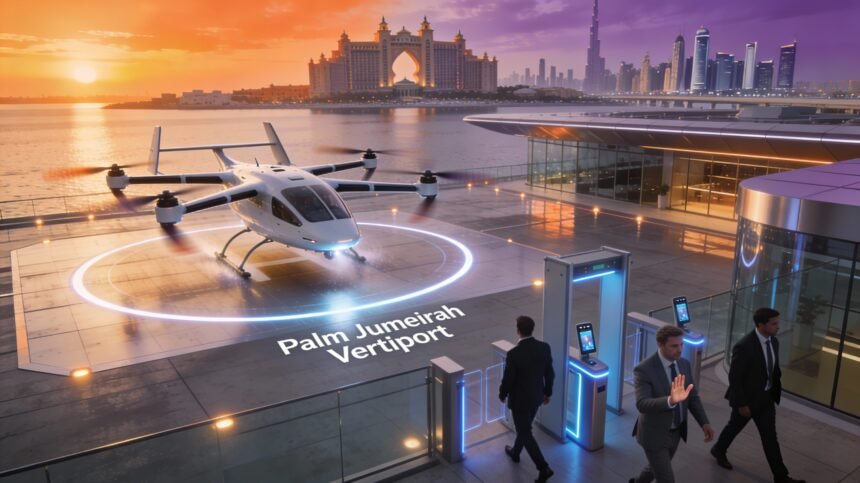
The journey begins not at a chaotic airport gate, but at the new “Vertiport” terminal adjacent to Dubai International Airport (DXB). Check-in is biometric, no passports, no boarding passes. A quick facial scan opens the gate.
The aircraft, manufactured by California-based Joby Aviation, looks like a hybrid between a helicopter and a drone. It seats four passengers and a pilot.
Unlike a helicopter, which shudders and roars, the Dubai flying taxi launch 2026 experience is shockingly quiet. As the six electric rotors spin up, the sound is a low hum, comparable to a heavy rain shower.
“The silence is the engineering breakthrough,” explains Engineer Sarah Al-Mansoori, a project lead at the Roads and Transport Authority (RTA). “We couldn’t have these landing in Downtown or the Marina if they sounded like helicopters. The electric propulsion allows us to operate without disturbing the residents below.”
The Route Map: Four Key Hubs
For 2026, the network is focused on the city’s highest-traffic corridors. The service currently operates between four strategic Vertiports designed by Skyports Infrastructure:
- DXB Airport (Terminal 3): The primary gateway for arrivals.
- Downtown Dubai: Located near the Burj Khalifa, serving the business district.
- Dubai Marina: Serving the residential and media hubs.
- Palm Jumeirah: Situated near Atlantis The Royal, serving luxury tourism.
The time savings are difficult to comprehend until you experience them. Our flight from DXB to the Palm Jumeirah took exactly 11 minutes. By car, during peak evening rush hour, the same journey would have taken 65 to 75 minutes.
The Price Tag: Uber Black in the Sky?
When the project was first announced, skeptics assumed tickets would cost thousands of dirhams. However, the Dubai flying taxi launch 2026 has aimed for a surprisingly accessible price point.
The RTA has confirmed a dynamic pricing model.
- Launch Price: Approximately AED 350 ($95) per seat for a one-way trip between DXB and the Marina.
- Comparison: A standard Uber Black or limo service for the same route typically costs AED 180-220.
“We are positioning this as a premium efficiency tool, not a billionaire’s toy,” says a spokesperson for Joby Aviation. “The premium over a luxury car is roughly 60%, but you are buying back an hour of your life. for a business executive, that math works.”
Safety and Regulation
The most significant hurdle for the Dubai flying taxi launch 2026 was not technology, but regulation. The UAE’s General Civil Aviation Authority (GCAA) has written the world’s first comprehensive rulebook for commercial eVTOL operations.
The safety protocols are redundant. The aircraft can fly safely even if one or more rotors fail. Furthermore, the pilots for this inaugural year are some of the most experienced aviators in the industry, many recruited from former air force and commercial airline backgrounds.
What’s Next? The “Inter-Emirate” Hop
While 2026 is about conquering Dubai’s traffic, the 2027 roadmap is already being drawn. Plans are underway to expand the network to Abu Dhabi and Ras Al Khaimah.
Imagine living in a villa in Ras Al Khaimah and commuting to your office in DIFC in 20 minutes. That reality is the next phase of the Dubai flying taxi launch 2026.
As we touched down on the Palm Jumeirah vertiport, watching the sunset reflect off the skyline, one thing was clear: The geometry of the city has changed. Dubai is no longer a linear strip along the coast; it is a 3D grid, and the sky is finally open for business.