




As Western tech giants race for dominance, the UAE and Saudi Arabia are building their own “Sovereign AI” brains to ensure the next generation learns in their own language and with their own values.
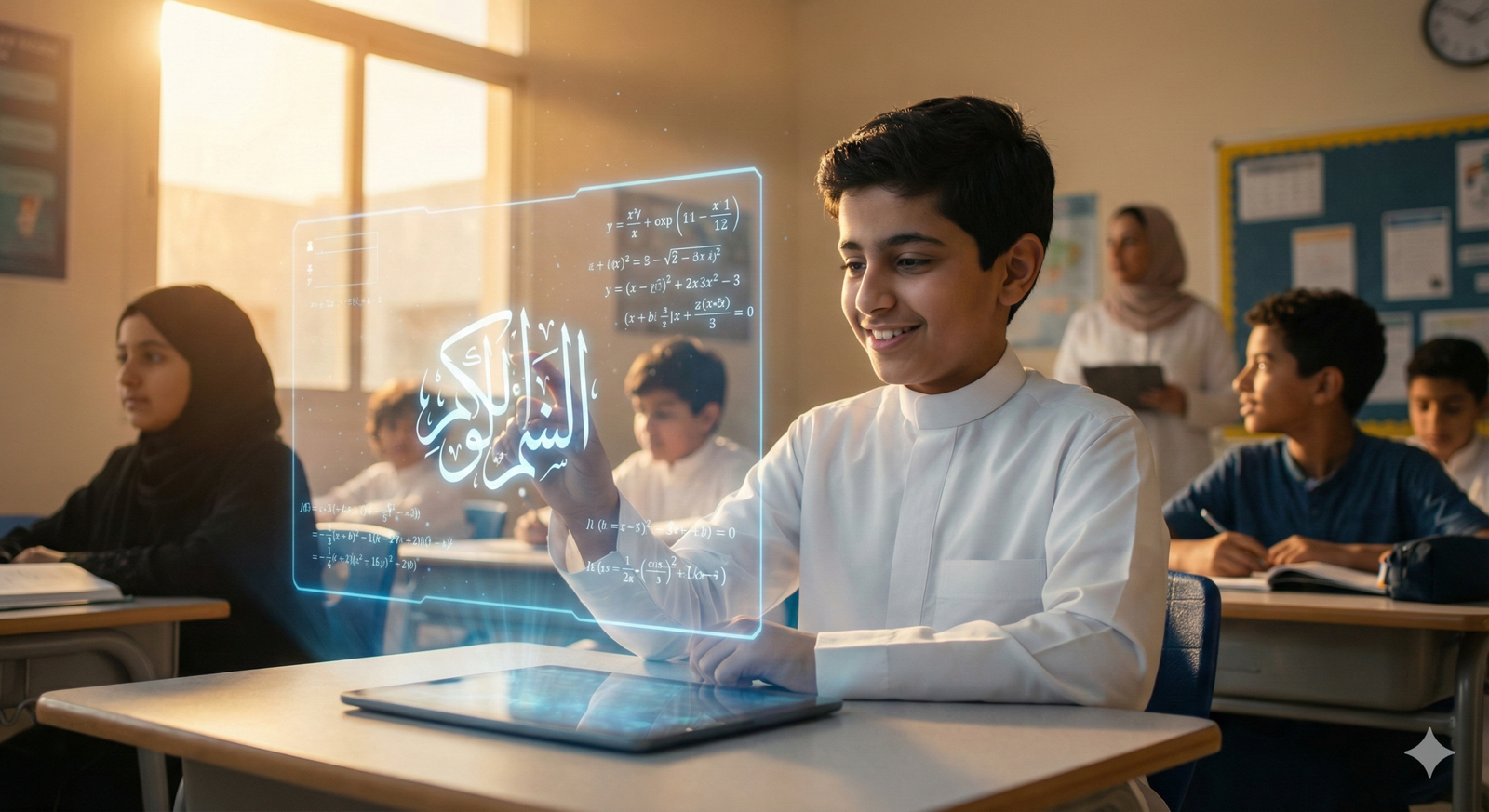
In a brightly lit classroom in Riyadh, 10-year-old Omar is struggling with a complex algebra problem. He doesn’t raise his hand to wait for the teacher, who is busy with another group. Instead, he taps a microphone icon on his tablet and asks for help, in the local Saudi dialect.
The voice that responds doesn’t sound robotic, nor does it sound like a translated version of a Silicon Valley chatbot. It understands his dialect, references a local cultural example to explain the math concept, and guides him to the answer without giving it away.
This is not Science Fiction. It is the reality of the 2025-2026 academic year across the Gulf, driven by a powerful new concept: Sovereign AI.
For years, the education sector feared that Artificial Intelligence would be a “Trojan Horse” a tool that, while useful, would flood Arab classrooms with Western biases, English-centric content, and foreign cultural norms. But today, the UAE and Saudi Arabia are flipping the script. They aren’t just importing AI; they are building their own.
The Rise of the “National Brain”
“Sovereign AI” refers to a nation’s capability to produce its own artificial intelligence using its own infrastructure, data, and workforce. In education, this distinction is critical.
“If you rely on a model trained entirely in California to teach your children history or ethics, you are outsourcing your culture,” says Dr. Ahmed Al-Mansoori, a Dubai-based EdTech analyst. “The GCC realized early on that to protect our narrative, we needed to own the code.”
Two giants have emerged to lead this charge: Jais in the UAE and ALLaM in Saudi Arabia.
Jais: The UAE’s Linguistic Guardian
Named after the highest peak in the UAE, Jais was developed by Inception (a G42 company) and the Mohamed bin Zayed University of Artificial Intelligence (MBZUAI). Unlike global models that treat Arabic as a second-tier language, Jais was trained on a massive dataset of high-quality Arabic text.
In 2025, this model is the engine behind the Ministry of Education’s new AI initiatives. It powers “AI Tutors” that can grade essays in Arabic with the same nuance as a human professor, detecting subtleties in poetry and prose that Western models routinely miss. It ensures that when a student asks a question about local geography or Islamic history, the answer is accurate, respectful, and locally grounded.
ALLaM: The Voice of Vision 2030
Across the border, Saudi Arabia’s Data & AI Authority (SDAIA) has deployed ALLaM, a premier Arabic Large Language Model (LLM). As part of the Kingdom’s “Human Capability Development Program”, a pillar of Vision 2030, ALLaM is being integrated into the national learning management systems.
Its impact goes beyond just translation. ALLaM is being used to create personalized learning paths for millions of students. It analyzes a student’s performance in real-time, identifying gaps in understanding and generating custom quizzes to bridge them. Crucially, it operates within a “cultural firewall,” ensuring all content aligns with Saudi values.
Alef Education: The Classroom Co-Pilot
While the government builds the models, private innovators are building the interface. Alef Education, the Abu Dhabi-based EdTech leader, has been at the forefront of this application.
Their latest “AI Tutor,” developed in partnership with the Ministry of Education and US-based Liquid AI, is not a replacement for teachers but a “Co-Pilot.”
“The teacher remains the captain of the ship,” explains an Alef Education spokesperson. “The AI acts as the navigator.”
By handling the heavy lifting, grading routine homework, answering repetitive questions, and tracking attendance, the AI frees up teachers to do what machines cannot: mentor, inspire, and provide emotional support. Early pilots in Abu Dhabi schools have shown a 40% reduction in teacher administrative workload, allowing for more one-on-one time with students who are falling behind.
Preserving the “Lughah” (Language)
Perhaps the most profound impact of Sovereign AI is on the Arabic language itself. For a decade, educators warned that the internet was creating a generation of “Arabizi” speakers, youth who could only express complex technical ideas in English.
Sovereign AI is reversing this trend. By proving that advanced physics, coding, and philosophy can be taught effectively in high-level Arabic, these models are restoring prestige to the mother tongue.
“We are seeing students discuss coding algorithms in Arabic for the first time,” notes Dr. Al-Mansoori. “Because the AI speaks the technical language of the future in the language of their ancestors.”
The Future: The Class of 2030
As we look toward 2030, the classroom of the future is taking shape. It is a hybrid space where physical textbooks coexist with holographic tutors, and where data sovereignty ensures that a student’s learning record remains private and protected within national borders.
The West may have invented the microchip, but by investing billions in Sovereign AI, the Middle East is ensuring that the software running on it speaks the language of the region. For the students of 2025, the future isn’t just bright; it’s familiar.