

While the moral case for sustainable cities is clear, the financial case is even stronger. A look at how green urbanism is becoming the region’s smartest investment strategy.
In his recent and compelling article, “The Road to a Green Future,” His Excellency Dr. Abdullah Belhaif Al Nuaimi issued a clarion call for the region. As the former Minister of Climate Change and Environment, his focus on the road to COP30 and the urgent need for carbon-neutral cities is scientifically undeniable. He paints a vision of human-centric urban planning, cities built for people, not just cars; infrastructure designed for longevity, not just utility.
But reading between the lines of Dr. Abdullah’s environmental roadmap reveals a secondary, equally powerful narrative, one that speaks the language of investors, developers, and sovereign wealth funds.
The vision he outlines isn’t just about saving the environment. It is, arguably, the most sophisticated economic diversification strategy available to us. When we strip away the moral arguments for sustainability, what remains is a cold, hard financial truth: In the new economy, green assets are simply worth more.
The Myth of the “Cost” of Sustainability
For too long, the private sector has viewed sustainable urban planning through the lens of “cost.” The assumption has been that building green, adding district cooling, sourcing renewable materials, or designing walkable districts, eats into profit margins.
However, market realities have flipped this equation. Dr. Abdullah’s push for sustainable transport and low-emission zones aligns perfectly with global capital flows. Today, a “Glass Box” tower that relies 100% on inefficient air conditioning is not an asset; it is a liability waiting to happen.
Global real estate data, from entities like Knight Frank to JLL, now consistently shows a “Green Premium.” Buildings with high sustainability ratings don’t just save energy; they command higher rents, attract blue-chip multinational tenants, and hold their resale value far better than their conventional counterparts.
Dr. Abdullah proposes a shift towards public transport and reducing oil consumption in cities. Economically, this translates to “efficiency.” Every Dirham saved on wasted energy or grid congestion is a Dirham that can be reinvested into innovation and growth.
The Walkability Dividend
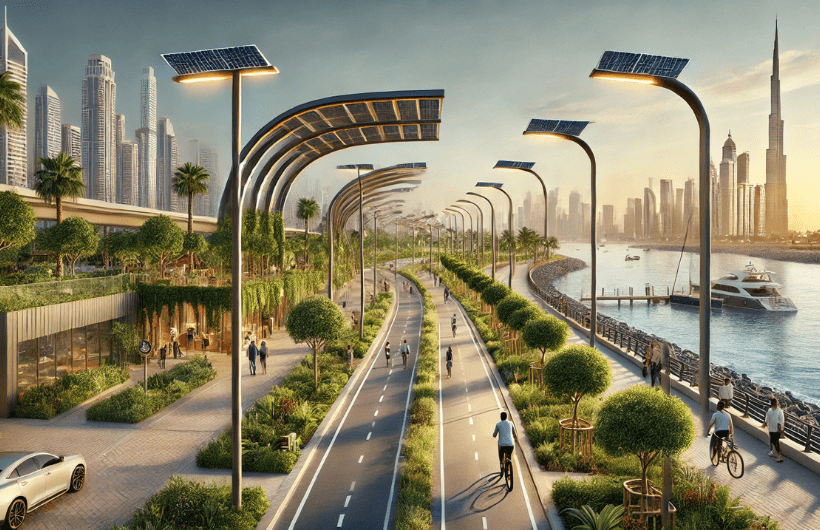
One of the most striking points in Dr. Abdullah’s analysis is the need for “human-centered cities” designed for pedestrians and cyclists. While this creates a healthier population, it also creates a wealthier local economy.
Urban economics teaches us a simple lesson: cars don’t buy coffee; people do.
When we design neighborhoods that prioritize walking as seen in Expo City or the new master plans for Dubai 2040, we increase the “velocity of money” within that community. Footfall drives retail. Shaded walkways and accessible transit turn a transit route into a commercial corridor. By advocating for this shift, Dr. Abdullah is essentially advocating for a boost in local retail GDP.
Future-Proofing Dubai’s Real Estate
Perhaps the most critical takeaway from his insights is the concept of resilience. We are moving towards a world of strict carbon regulations. By pushing for this transformation now, ahead of global mandates like COP30, leaders like Dr. Abdullah are ensuring that the UAE’s infrastructure remains “future-proof.”
Developers who ignore this shift risk holding “stranded assets”, buildings that become too expensive to operate or illegal to lease under future regulations. Following the roadmap laid out by Dr. Abdullah is the ultimate form of risk management for the private sector.
Validation of a Vision
Dr. Abdullah Belhaif Al Nuaimi writes with the foresight of a statesman who understands that our relationship with nature dictates our future. At The Nation, our analysis suggests that his vision also dictates our prosperity.
The transition to sustainable cities is not a burden on the economy; it is the engine of the next cycle of growth. It attracts foreign direct investment, retains high-quality talent who seek a better lifestyle, and increases the valuation of our real estate.
His Excellency’s article is more than environmental advocacy; it is a blueprint for economic resilience. The “Green Future” he envisions is also a golden era for smart investment.