



Four years after signing the historic CEPA, the UAE and India have smashed their 2030 trade target four years ahead of schedule. As the massive ‘Bharat Mart’ opens in Jebel Ali, the two nations are launching ‘CEPA 2.0’, a new digital corridor that replaces shipping containers with data packets.
In 2022, when the United Arab Emirates and India signed the Comprehensive Economic Partnership Agreement (CEPA), the goal was ambitious but distant: to reach $100 billion in non-oil trade by 2030.
In April 2026, the history books have been rewritten.
According to data released this morning by the UAE Ministry of Economy and India’s Ministry of Commerce, the two nations have officially crossed the $100 billion non-oil trade threshold, four years ahead of schedule.
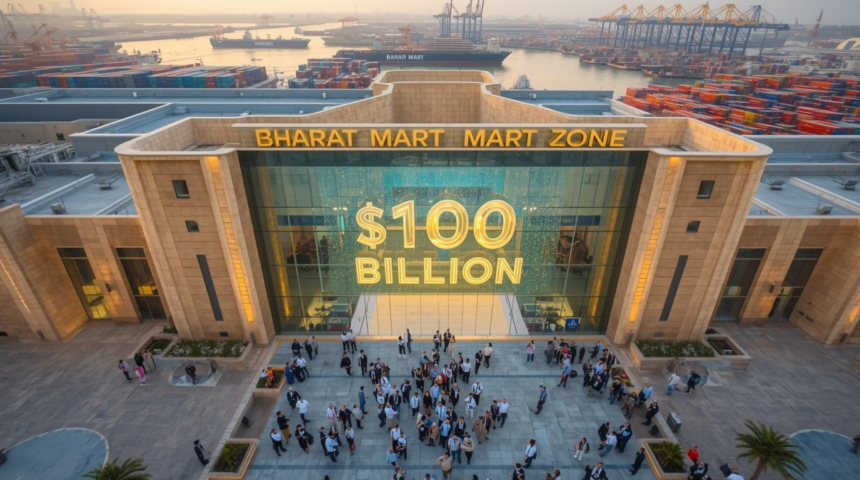
To mark this economic velocity, dignitaries from both nations gathered in Jebel Ali today for a double celebration: the official inauguration of Bharat Mart, and the launch of what diplomats are calling “CEPA 2.0.”
Bharat Mart: The “Dragon Mart” for India
If you want to understand the scale of this partnership, you have to drive to Jebel Ali Free Zone (Jafza).
Rising from the desert sands is Bharat Mart, a colossal 2.7 million square foot facility that promises to do for Indian exporters what Dragon Mart did for Chinese manufacturers two decades ago.
Jointly developed by DP World and the Indian government, the facility is effectively a “sovereign showroom.”
- The Scale: It houses 1,500 showrooms and vast Grade-A warehousing space.
- The Function: It allows Indian manufacturers, from textiles in Surat to heavy machinery in Chennai, to store goods in Dubai, duty-free, and re-export them to Africa and Europe with overnight delivery.
- The Impact: “This cuts the logistics time for Indian MSMEs (Micro, Small and Medium Enterprises) by 40%,” explains Sultan Ahmed bin Sulayem, Group Chairman of DP World. “Instead of shipping from Mumbai to Mombasa, they ship to Jebel Ali, store it here, and we handle the last mile.”
For the Indian exporter, Bharat Mart is not just a warehouse; it is a forward operating base.
CEPA 2.0: The Digital Trade Corridor
While Bharat Mart handles the physical atoms, CEPA 2.0 is about the digital bits.
The centerpiece of this new phase is the “Virtual Trade Corridor.” This initiative fully integrates the UAE’s Jaywan domestic card scheme with India’s Unified Payments Interface (UPI) and RuPay stack.
“In 2022, we lowered tariffs. In 2026, we are lowering friction,” says Dr. Thani Al Zeyoudi, UAE Minister of State for Foreign Trade. “A tourist from Jaipur can now buy gold in the Dubai Gold Souk using their UPI app, with instant currency conversion and zero swift fees. A business in Abu Dhabi can pay a supplier in Bangalore in Dirhams, and they receive Rupees instantly.”
This financial integration bypasses the US Dollar for bilateral trade, reducing transaction costs by an estimated 4-5%, a massive margin in the commodities business.
The “Innovation Bridge”: AI and Energy
The “2.0” framework also shifts the focus from commodities (gems and jewelry) to advanced technology.
The UAE-India CEPA Council, launched back in 2024, has facilitated a surge in cross-border venture capital.
- AI: G42, the UAE’s AI champion, has announced a new $1 billion compute fund specifically for Indian AI startups to train their models on UAE supercomputers.
- Energy: The grid interconnection project is moving forward. Feasibility studies were completed this month for an undersea high-voltage cable that would allow solar power generated in Rajasthan to power homes in Fujairah during peak hours.
The Geopolitical Context: The “IMEC” Factor
This bilateral boom comes against the backdrop of the wider India-Middle East-Europe Economic Corridor (IMEC).
While regional instability in the Levant has slowed the “Northern Corridor” (rail links to Haifa), the “Eastern Corridor” (India to UAE) is thriving. The UAE is effectively positioning itself as India’s gateway to the West.
“India is the factory; UAE is the showroom,” notes a geopolitical analyst at the Observer Research Foundation. “With global supply chains fracturing, India needs a neutral, hyper-connected hub to reach the world. Dubai is that hub.”
The Next Target: $200 Billion?
With the $100 billion milestone in the rearview mirror, the question is: What next?
Insiders suggest a new target of $200 billion by 2035 is being drafted. But the focus is no longer just on volume; it is on value.
“The first phase was about selling rice and oil,” says the Indian Ambassador to the UAE. “The next phase is about selling semiconductors, data, and clean hydrogen. Bharat Mart is just the first brick in a much larger edifice.”
As the ribbon was cut at Jebel Ali today, the mood was electric. The “Iron Brothers” of the 21st century have built a trade engine that is firing on all cylinders, and it shows no sign of slowing down.