


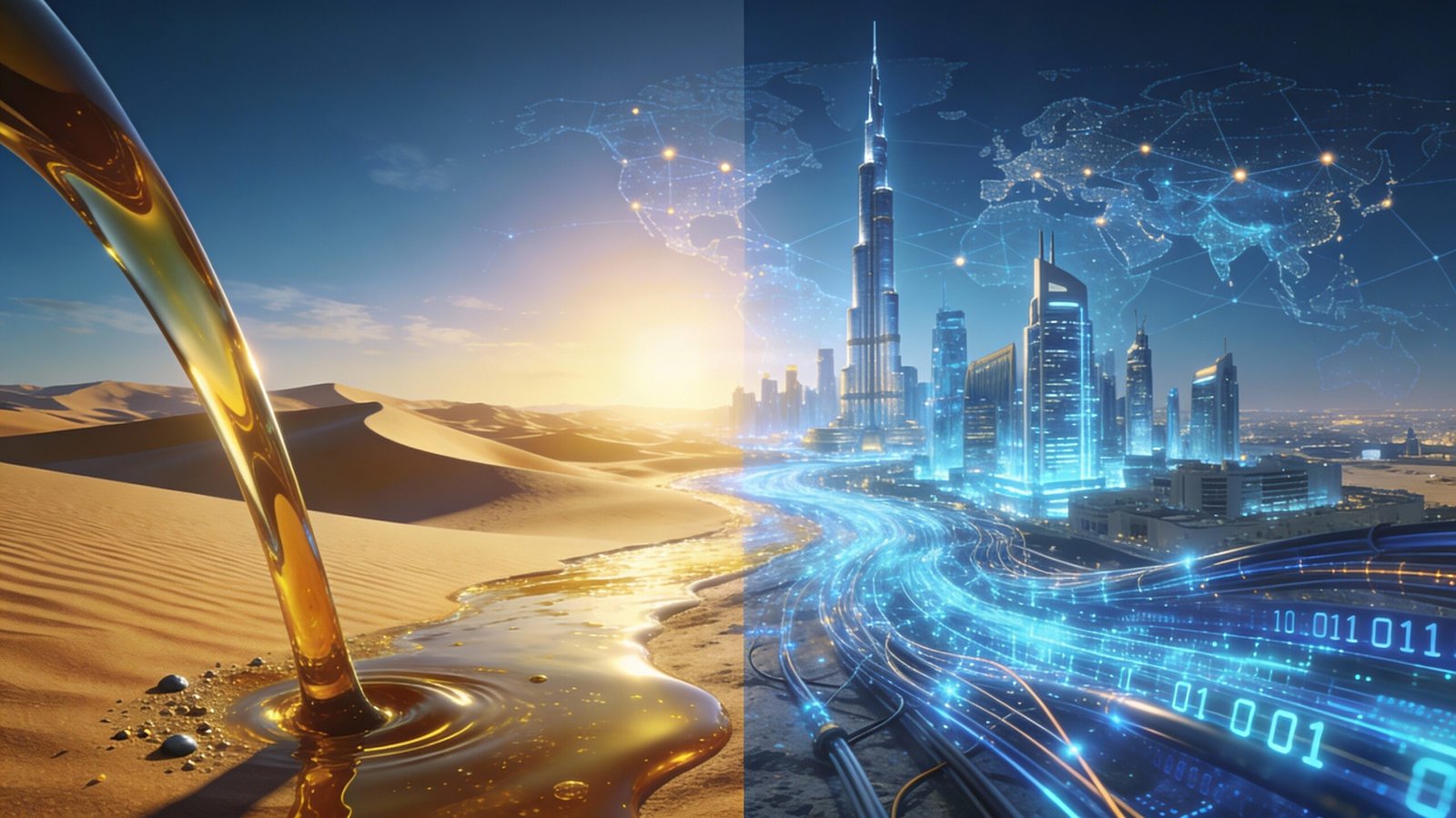
As the UAE shifts from a hydrocarbon economy to a global trade nexus, the AED 32 Trillion roadmap offers a new playbook for foreign direct investment, moving from passive asset holding to active sovereign partnership.
The End of the Petrodollar Narrative
For the better part of a century, the economic narrative of the Middle East was written in a single commodity: oil. Global investors viewed the region through a binary lens, when oil prices were high, liquidity flowed; when they dropped, capital retreated. It was a cyclical, predictable, and ultimately limited worldview.
However, on January 4, 2023, that narrative was officially retired. With the launch of the Dubai Economic Agenda (D33), His Highness Sheikh Mohammed bin Rashid Al Maktoum did not just announce a new policy; he unveiled a new operating system for the global economy. The ambition is numerical and staggering: to double the size of Dubai’s economy over the next decade, targeting a total economic volume of AED 32 trillion (approx. $8.7 trillion). The goal is to consolidate Dubai’s position as one of the top three global economic cities, alongside New York and London.
But for the sophisticated investor, the private equity partner in London, the venture capitalist in Silicon Valley, or the family office head in Singapore, the value of the D33 Agenda does not lie in the headlines. It lies in the infrastructure of opportunity being built beneath the surface. This is not merely a spending plan; it is a structural pivot from a “Hard Asset” economy (real estate, ports, tourism) to a “Soft Power” economy (data, digital sovereignty, intellectual property, and high-tech manufacturing).
This article decodes the “Multiplier Effect” of the D33 Agenda, analyzing where the smart money is moving and why the traditional playbook for investing in the Gulf is now obsolete.
The Mathematics of Ambition
To understand the investment opportunity, one must first digest the scale of the mandate. The D33 Agenda includes 100 transformative projects, but the core targets signal specific sectors of high growth:
- Foreign Trade: Raising the total value of foreign trade from AED 14.2 trillion in the past decade to AED 25.6 trillion in the next decade.
- FDI Inflow: Increasing Foreign Direct Investment from an annual average of AED 32 billion to AED 60 billion annually.
- Private Sector Investment: Boosting private sector investments from AED 790 billion to AED 1 trillion.
These figures are not aspirational fluff; they are backed by sovereign liquidity and regulatory reform. The “Multiplier Effect” here refers to the government’s strategy of using state capital to de-risk sectors, thereby allowing private capital to enter with higher confidence and higher potential returns.
For instance, when the government invests billions in Green Hydrogen infrastructure, it isn’t just building power plants; it is creating a supply chain vacuum. It needs private companies to build the storage solutions, the transport logistics, and the software to manage the grid. The state builds the road; the private sector is invited to build the cars.
The Shift to ‘Soft Infrastructure’
Historically, Dubai’s growth was visible on the skyline. It was about concrete, steel, and reclaiming land from the sea. The next phase of growth will be invisible, hosted on servers and secured by blockchain.
The D33 Agenda explicitly targets the digital economy, aiming to generate an annual contribution of AED 100 billion from digital transformation projects. This signals a massive pivot from “Hard Infrastructure” to “Soft Infrastructure.”
For the global investor, this opens a specific corridor of opportunity: Data Residency and Sovereign Tech. The UAE is aggressively positioning itself as a “Digital Safe Haven.” Just as Switzerland became the banking vault of the 20th century, Dubai aims to become the “Data Vault” of the 21st. With the introduction of the Virtual Assets Regulatory Authority (VARA) and robust data protection laws, the emirate is building a regulatory sandbox that attracts Fintech, Web3, and AI companies that are stifled by over-regulation in the West or instability in the East.
The opportunity here is for B2B Tech Infrastructure. Companies that provide the cybersecurity, cloud architecture, and digital compliance tools to help Dubai build this “Digital City” are seeing unprecedented demand. The government is no longer just buying technology; they are incubating it. They are looking for partners who can transfer knowledge and IP to the region, offering long-term contracts and “Golden Visas” as incentives.
The Manufacturing Renaissance – “Make it in the Emirates”
Perhaps the most counter-intuitive pillar of the D33 is the focus on manufacturing. Conventional economic wisdom suggests that high-income nations eventually outsource manufacturing to low-cost jurisdictions. Dubai is defying this trend.
The “Make it in the Emirates” initiative is not about competing with Bangladesh on textiles or China on cheap electronics. It is about High-Value, Precision Manufacturing. The D33 agenda leverages Dubai’s logistics dominance, anchored by DP World, Jebel Ali Port, and Emirates SkyCargo, to position the emirate as a manufacturing launchpad for the Global South.
Why manufacture in Dubai?
- Geopolitical Neutrality: In a world of fractured supply chains and sanctions, the UAE remains a neutral trade broker, accessible to East and West.
- Energy Advantage: Access to reliable, low-cost energy (and increasingly clean energy) is a massive competitive advantage for energy-intensive industries like aluminum, green steel, and pharmaceuticals.
- Market Access: A factory in Dubai is within an 8-hour flight of two-thirds of the world’s population, including the exploding consumer markets of Africa and India.
For private equity, the play here is “Industrial Real Estate” and “Logistics Tech.” Investing in the automated warehouses, the cold-chain logistics for pharma, and the 3D printing facilities that support this industrial ambition is the new frontier of asset-backed growth.
The Role of Global Private Capital
So, where does the Foreign Investor fit in? The era of “Passive Capital” is ending. Previously, a foreign investor might buy a floor in a skyscraper or park money in a local bond and wait for yields. The D33 Agenda encourages “Active Participation.”
The government is actively seeking to privatize and list state-owned enterprises, deepening the financial markets. But more importantly, they are creating “Sandboxes”, controlled environments where international startups can test products with real-world data and government support.
The “Sandbox Dubai” Program aims to make Dubai a major hub for incubating innovation. This is a call to Venture Capitalists: Bring your portfolio companies here. If you have a startup solving water scarcity, food security, or urban mobility, Dubai will not just be your market; it will be your laboratory.
Furthermore, the integration of 65,000 additional UAE nationals into the workforce means that foreign companies establishing HQs in Dubai must be ready to integrate local talent. This is not a burden but a strategic asset—these are young, digitally native citizens who understand the nuances of the regional market better than any expat consultant.
The India-UAE Corridor Connection
No analysis of the D33 is complete without mentioning its external engines. The deepening strategic alliance with India, exemplified by the CEPA (Comprehensive Economic Partnership Agreement), is a cornerstone of this growth.
With bilateral trade targets set at $100 billion, Dubai is positioning itself as the offshore headquarters for India Inc. As Indian unicorns look to go global, Dubai is their natural stepping stone, offering better tax structures, global connectivity, and a lifestyle that retains top talent. For investors, looking at companies that sit at the intersection of the India-UAE Corridor (logistics, fintech, agri-tech) creates a double-exposure to two of the fastest-growing GDPs in the world.
The Window for “Founding Partners”
The Dubai Economic Agenda (D33) is not a forecast; it is a funded, sovereign mandate. The government has put its balance sheet behind this transition, effectively de-risking the entry for early movers.
However, markets mature quickly. The “Infrastructure Phase”, where the rules are written and the primary assets are allocated, is happening right now. We are currently in the window where strategic investors can secure “Founding Partner” status. This means access to prime digital real estate, favorable regulatory treatment, and first-mover advantage in the new industrial zones.
For the global C-Suite and the institutional investor, the message from Dubai is clear: The old oil economy is history. The new economy is open for business. The question is no longer if you should have exposure to the Gulf, but how much and how fast.
The D33 is the blueprint. Capital is the fuel. And for those who can read the map, the road to 2033 is paved with unprecedented opportunity.