


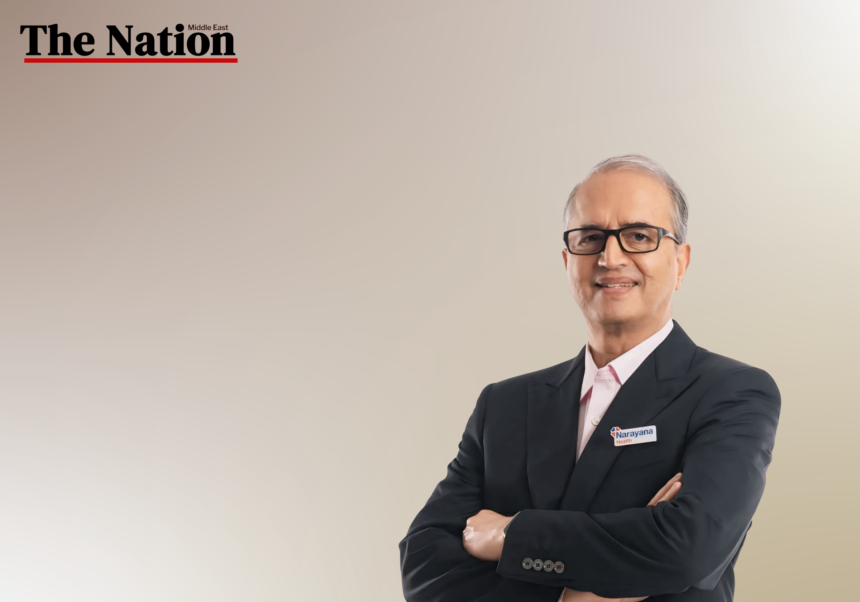
From the landmark acquisition of the UK’s Practice Plus Group to the “Udaan” medical education mandate, the Narayana Health founder is dismantling the traditional “Profit-per-Bed” model to create a $3,000 Crore “Sovereign Health Stack.”
In the high-stakes evolution of global healthcare, few figures command as much respect for both their surgical precision and their industrial scale as Dr. Devi Prasad Shetty. As of February 2026, the man often referred to as the “Henry Ford of Heart Surgery” has moved beyond the operating theater to become a global infrastructure architect. Through a series of aggressive international acquisitions and a radical “Digital-First” domestic expansion, Dr. Shetty is attempting to solve the world’s most complex economic puzzle: how to decouple high-quality medical outcomes from the patient’s bank balance.
The London Bridge: Rescuing the NHS Model
The most explosive development in Dr. Shetty’s 2026 portfolio is the ₹2,200 crore ($265 million) acquisition of the UK’s Practice Plus Group (PPG). This move is a historic reversal of the traditional colonial narrative. Narayana Health (NH) is no longer just an Indian success story; it is now a critical provider for the British National Health Service (NHS).
By integrating PPG into the NH ecosystem, Dr. Shetty is exporting the “Indian Efficiency Model” to a mature, struggling European market. He is betting that the high-volume, low-cost methodologies perfected in Bengaluru can stabilize the UK’s surgical backlogs. This “India-UK-Cayman” corridor creates a unique data-sharing loop, where surgical techniques and AI-driven diagnostic tools are refined in real-time across three continents.
Project “Udaan”: Solving the Human Deficit
While the world focuses on hospital beds, Dr. Shetty is focusing on the people who staff them. In early 2026, he unveiled Project “Udaan,” a massive initiative to bridge the global deficit of doctors and nurses. This isn’t just a training program; it is a policy manifesto. Dr. Shetty is advocating for a “Work-Study” model where nursing and medical education are integrated directly into the hospital workflow, drastically reducing the cost of becoming a healthcare professional.
Domestically, Narayana Health has committed to a ₹3,000 crore capital expenditure plan through 2026. This includes the launch of “Narayana Healthcare North,” a strategic expansion into the Delhi-NCR and Raipur clusters. By adding over 1,500 ICU-grade beds, Shetty is preparing for a future where hospitals are no longer “hotels for the sick” but high-tech processing centers for complex interventions.
The “MANAV” Health Stack: AI as the Safety Net
At the India AI Impact Summit in February 2026, Dr. Shetty provided a rare look into his technological “under-the-hood.” He revealed that 90% of NH patient data is now fully digitized, allowing the group to deploy predictive AI that monitors patient vitals hours before a crisis occurs.
His vision for AI is “Sovereign and Ethical.” Unlike models that seek to replace doctors, Shetty’s AI serves as a “Digital Safety Net,” handling the administrative burden that currently consumes 40% of a physician’s time. For the Middle East market, specifically The Nation ME readers, this signals a shift toward “Managed Care.” By using data to prevent illness rather than just treating it, NH is moving toward an insurance-integrated model (under the “Aditi” brand) that rewards hospitals for keeping people out of beds.
The $14 Billion Legacy: ROTI over ROI
As Dr. Shetty’s net worth reflects the scaling of his empire, his personal metric remains ROTI (Return on Time Invested). He has become a vocal critic of the “Protectionist” mindset in medical education, urging governments to treat healthcare as a strategic infrastructure rather than a service industry.
His 2026 roadmap is clear: By 2030, he intends for Narayana Health to be the first “Global Health Utility”, a platform where the cost of a heart surgery is as standardized and transparent as a digital transaction. As he bridges the gap between the developed West and the developing East, Dr. Devi Shetty is proving that the greatest innovation in medicine isn’t a new drug or a robot, but a new way of thinking about the value of a human life.