



The prototype phase is over. Emaar has officially launched sales for ‘The Curve’ in Dubai South, a community of 200 luxury villas built not by bricklayers, but by robots. We analyse the speed, the sustainability, and the AED 5 million price tag.
For the past five years, 3D-printed houses were essentially PR stunts. A small office here, a single prototype villa there, proof of concepts that were interesting but not scalable.
In April 2026, the stunt has become a subdivision.
This week, master developer Emaar Properties, in partnership with Dubai South, unveiled “The Curve”, the world’s first fully commercialised, 3D-printed luxury villa compound. Unlike the experimental units of the past, these are not small pods. They are sprawling 4-bedroom family homes, featuring the organic, flowing architecture that only a printer can achieve.
With the Dubai 3D Printing Strategy 2030 mandating that 25% of all new buildings be printed, this launch marks the moment the technology moved from “Science Fiction” to “Standard Practice.”
The Speed of Light (Concrete)
The most shocking statistic of the launch wasn’t the price; it was the timeline. Traditional construction for a 4,000 sq. ft. villa takes 12 to 14 months. At The Curve, the concrete shell of a villa is printed in 14 days.
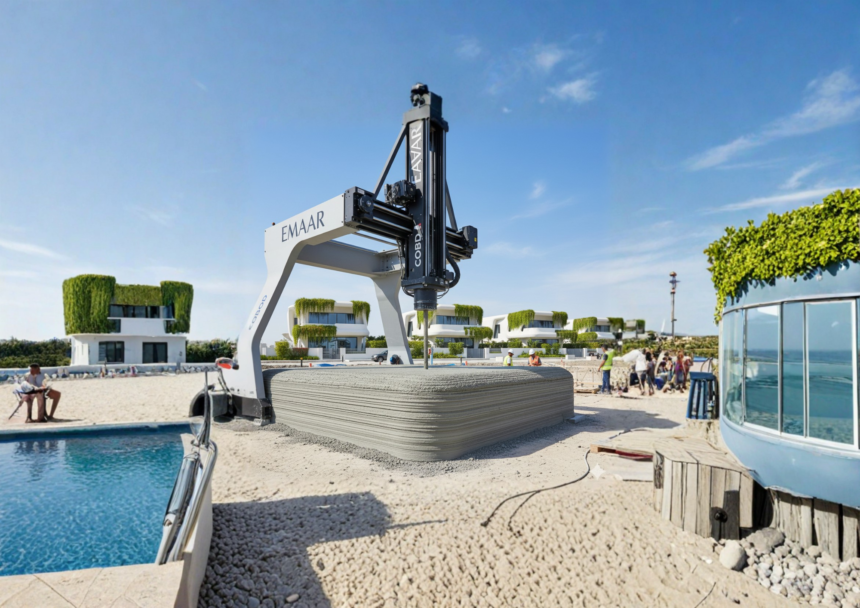
“We have fundamentally broken the time-cost triangle,” said an Emaar spokesperson at the launch event in Dubai South. “By using the new generation of COBOD gantry printers, we can print three villas simultaneously on a single street. There is no formwork, no scaffolding, and zero waste.”
The printer runs 24/7, requiring only a skeleton crew of three technicians to monitor the nozzle flow. The result is a construction site that is eerily quiet, no jackhammers, just the low hum of the servo motors layering concrete like icing on a cake.
The Design: No Straight Lines
If you drive past the site near Al Maktoum International Airport, you immediately notice the difference. There are no corners.
3D printing excels at curves, which are historically expensive to build with traditional molds. The villas at The Curve feature undulating walls that mimic sand dunes, improving structural integrity and thermal insulation.
- Thermal Mass: The hollow-wall technology allows for air gaps that naturally cool the house, reducing AC consumption by an estimated 30%.
- Customization: Buyers can theoretically “edit” the floor plan of their villa hours before the printing begins, moving a wall or expanding a window with a few clicks in the CAD file.
Read: Ras Al Khaimah Real Estate 2026: The ‘Wynn Effect’ and the Last Chance to Buy Early
The Economics: AED 5 Million for a ‘Print’?
The Emaar 3D printed villas Dubai 2026 are priced at a premium: AED 5.2 million for a 4-bedroom unit.
Critics argue this is high for an “automated” house. Shouldn’t robots make it cheaper? “We are in the ‘Tesla Roadster’ phase of the technology,” explains Faisal Durrani, a real estate analyst. “The cost of the printers and the specialized ink is still high. But you are paying for the exclusivity, the sustainability rating (LEED Platinum), and the speed. You get the keys in 6 months, not 18.”
However, Emaar predicts that as the compound expands to Phase 2 in late 2027, construction costs will drop by 40%, eventually making printed homes cheaper than traditional ones.
The Labor Impact: The End of the Hard Hat?
The launch of The Curve has reignited the debate about the future of construction labor. The site employs 70% fewer workers than a traditional site.
“We are moving from ‘labor-intensive’ to ‘tech-intensive’,” notes the Director of Dubai South. “Instead of 100 masons laying bricks in the sun, we have 10 robotics engineers monitoring data streams in an air-conditioned cabin. It aligns perfectly with the UAE’s goal of attracting high-skilled talent.”
Buyer Sentiment: Is it Safe?
The biggest hurdle remains psychological. Do people trust a house that was squirted out of a nozzle? Emaar addresses this with a 50-Year Structural Warranty, double the industry standard. The concrete mix used is three times stronger than conventional blocks.
“I was skeptical,” admits Sarah, an early buyer from the UK. “But when you touch the walls, they feel like solid granite. And the design is something you’d see in a sci-fi movie. It feels like I’m living in the future.”
The New Normal
As the gantry printers glide silently over the desert sand in Dubai South, they are layering more than just concrete; they are layering a new economic reality.
In 2026, the question is no longer “Can we print a house?” It is “Why would we build one any other way?” The Emaar 3D printed villas Dubai 2026 compound proves that the future of real estate isn’t just smart; it’s printed.