



It is the most expensive and ambitious hardware ever built by the Arab world. In 2026, the ‘Emirates Airlock’ enters its critical design phase, while a smaller, faster explorer, Rashid 2, prepares to touch the lunar surface.
For the past decade, the UAE’s space ambitions have been defined by “firsts.” The first satellite built by Arab engineers (KhalifaSat). The first Arab mission to Mars (Hope Probe). The first long-duration Arab astronaut mission (Sultan Al Neyadi).
In 2026, the narrative shifts from “visiting” space to “living” in it.
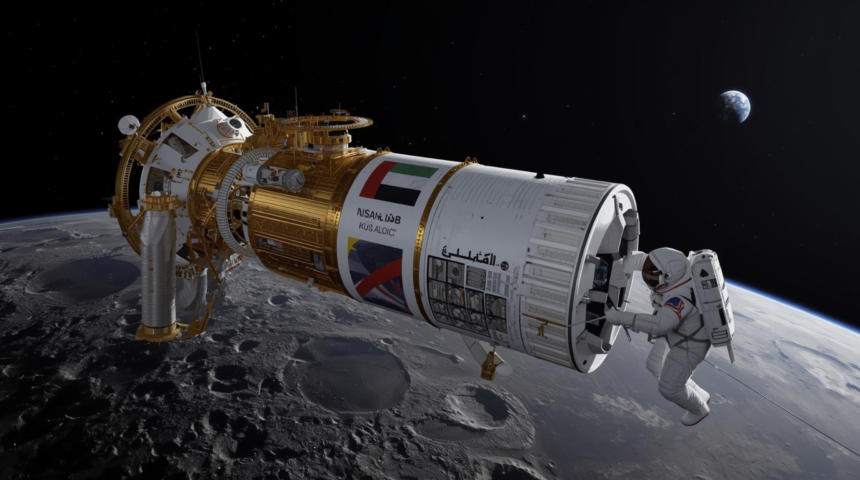
This year marks a pivotal synchronisation of the UAE’s two most critical lunar programs. While the Mohammed Bin Rashid Space Centre (MBRSC) finalises the blueprints for the UAE Airlock Lunar Gateway 2026, the massive 10-tonne module that will serve as humanity’s front door to the Moon, a smaller, grittier mission is already on the launchpad.
The Rashid 2 rover is scheduled to launch later this year, aiming to redeem the heartbreak of 2023 and cement the UAE’s status as a serious lunar player.
The Airlock: The $100 Million Doorway
The centerpiece of the UAE’s space policy is its contribution to Artemis, NASA’s program to return humans to the Moon. The UAE isn’t just sending a passenger; it is building the station.
In 2026, the Emirates Airlock has moved from a “concept” to a “critical design” phase.
“This is not just a metal tube,” explains Salem Al Marri, Director General of MBRSC. “The Airlock is the only way in and out of the Gateway station for spacewalks. Every time a human steps out to walk on the lunar orbit or install a science experiment, they will pass through Emirati hardware.”
The 2026 Status Report: Following the massive contract awarded to Thales Alenia Space (the prime contractor), engineers in Dubai and Turin are currently conducting the “System Requirements Review”. This is the engineering deep-dive where the physics of the 10-meter-long, 4-meter-wide module are finalized.
- Weight: 10 tonnes.
- Function: It serves as the crew lock for spacewalks (EVA) and a science airlock to deploy payloads into lunar orbit.
- Launch Target: While the module itself will launch closer to 2030 (likely on Artemis 6), the intellectual property and manufacturing protocols are being locked in now, in 2026.
The Astronauts: Nora and Mohammad Ready for Flight
The “quid pro quo” of the Airlock deal is historic: In exchange for building the module, a UAE astronaut is guaranteed a seat on a future Artemis mission to the Gateway.
This puts the spotlight firmly on Nora Al Matrooshi and Mohammad Al Mulla. Having graduated from NASA’s astronaut training program in early 2024, they are now fully qualified mission specialists.
In 2026, their training has shifted to specific Gateway systems. At the Johnson Space Center in Houston, they are currently simulating EVA (spacewalk) procedures using the very airlock designs their colleagues in Dubai are building.
“We are training for a station that doesn’t exist yet,” Al Matrooshi said in a recent press briefing. “But when it launches, we will know every bolt and valve because our country built it.”
Rashid 2: The Redemption Mission
While the Airlock is a long-term play, 2026 offers immediate kinetic action.
Rashid 2, the successor to the rover lost during the HAKUTO-R crash in 2023, is set to launch this year aboard the Firefly Aerospace ‘Blue Ghost’ lander.
Unlike its predecessor, Rashid 2 is not just a technology demonstrator. It is a hardened explorer designed to land on the Moon’s far side or a challenging polar region.
- The Mission: To study the Moon’s plasma environment and dust interactions.
- The Carrier: Firefly’s Blue Ghost Mission 2 is part of NASA’s CLPS (Commercial Lunar Payload Services) initiative. The lander will carry payloads from NASA, the European Space Agency, and the UAE.
- The Stakes: A successful landing in 2026 would make the UAE only the fourth nation (after the USSR, USA, China, and India) to successfully operate a rover on the lunar surface.
The Economy of Space
Beyond the flags and footprints, the UAE Airlock Lunar Gateway 2026 project is an economic engine.
By partnering with Thales Alenia Space, MBRSC is ensuring that “Technology Transfer” occurs. Emirati engineers aren’t just watching; they are co-developing the aluminum alloys and life-support seals.
This aligns with the wider Abu Dhabi Space Debate goals: to create a private space sector in the UAE that can bid for global contracts.
“We are seeing a shift in 2026,” notes a space policy analyst at the Atlantic Council. “The UAE is moving from being a buyer of space technology (like with the early satellites) to a supplier of critical infrastructure. If you want to walk on the Moon in 2030, you have to go through the UAE.”
Read: Halal Lab-Grown Meat Abu Dhabi 2026: The ‘Impossible’ Chicken is Here (And It’s 100% Halal)
The Year of the Blueprint
2026 might not be the year an Emirati walks on the Moon, but it is the year the ticket is stamped.
With Rashid 2 poised to touch the lunar soil and the Emirates Airlock taking shape in the engineering labs, the UAE has effectively booked its place in the next great era of exploration. The moon is no longer just a destination in the night sky; it is the next job site.