



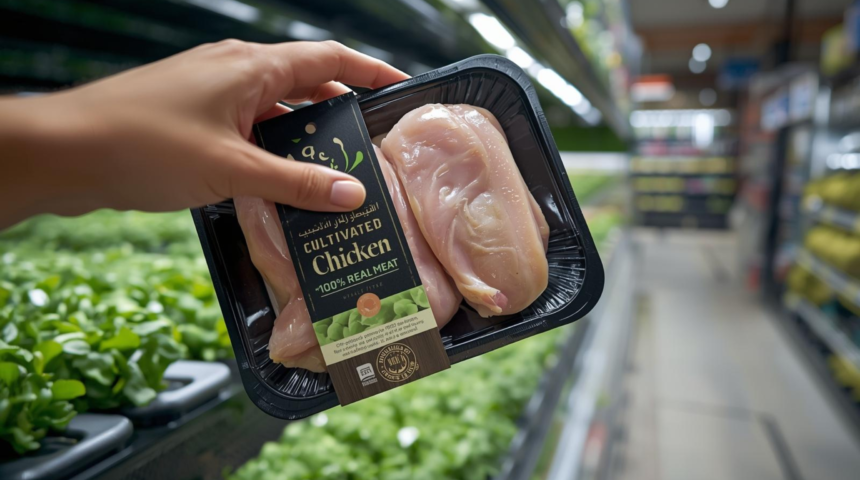
The theological debate is settled, the bioreactors are running, and the product is on the shelf. As Abu Dhabi becomes the first Arab capital to sell cultivated meat, we ask: Does it actually taste like chicken?
For years, the concept of “lab-grown meat” was stuck in a purgatory of science fiction and religious debate. It promised to save the planet, but for the Muslim world, it posed a singular, burning question: If it wasn’t slaughtered, is it Halal?
This week, in the aisles of a Spinneys in Al Maryah Island, that question was answered not with a fatwa, but with a price tag.
Sitting next to the organic free-range breast fillets is a sleek, black package labeled “Believer Meats: Cultivated Chicken.” It carries the official green Halal seal of the UAE Fatwa Council. It costs AED 45 per kilogram, roughly parity with premium organic chicken. And as of this morning, it is officially legal for sale in Abu Dhabi.
This moment marks the culmination of a three-year strategic sprint by the AgriFood Growth & Water Abundance (AGWA) cluster, which has turned the UAE capital into a global testbed for the future of protein.
The Halal Breakthrough: How They Did It
The journey to the supermarket shelf was paved by theologians as much as biologists.
In late 2024, the UAE Council for Fatwa issued a landmark ruling that paved the way for this industry. They determined that cultivated meat is Halal if it meets two strict conditions:
- The Source Cell: The master stem cell must be extracted from an animal that is Halal to consume (e.g., a chicken slaughtered according to Islamic rites).
- The Growth Medium: The nutrient soup used to feed the cells must be free of blood or non-Halal serum (specifically Fetal Bovine Serum).
Believer Meats, the Israeli-founded food tech giant which established its regional HQ in Abu Dhabi under the AGWA umbrella in 2024, adhered strictly to these protocols.
“We don’t just grow meat; we grow trust,” says Dr. Ahmed Al-Zarooni, a food safety consultant advising the project. “The bioreactors in our Khalifa Economic Zones Abu Dhabi (KEZAD) facility are monitored by Halal auditors just like a traditional slaughterhouse. The serum is plant-based. The cell line comes from a single chicken named ‘Noura’ who was slaughtered in accordance with Sharia law three years ago.”
The Taste Test: Biology, Not Chemistry
So, what does Halal lab-grown meat Abu Dhabi 2026 taste like?
Unlike “plant-based” alternatives (like Beyond Meat or Impossible Foods), which use pea protein and beetroot juice to mimic meat, this product is meat. It is biologically identical to chicken muscle tissue, simply grown outside the bird.
We bought a pack to cook in the office test kitchen.
- Texture: Raw, it feels slightly softer than traditional chicken, lacking the tough connective tissue or gristle you sometimes find.
- Cooking: It sears exactly like chicken. The Maillard reaction (browning) is identical because the amino acids are the same.
- Flavor: In a blind taste test with grilled lemon-herb seasoning, three out of four staff members could not tell the difference. The fourth identified it only because it was “too tender.”
“It’s the cleanest chicken you’ll ever eat,” notes Chef Marwan, who runs a fine-dining concept in Saadiyat. “No antibiotics, no salmonella risk, no hormones. For a chef, consistency is king, and this meat is molecularly consistent every time.”
Read More: Dubai Metro Blue Line Map 2026: Routes, Stations & Rents
The “AGWA” Engine: Food Security as National Defence
The arrival of this product is not a culinary gimmick; it is a pillar of national security.
The UAE traditionally imports 85-90% of its food. In a world of fragmenting supply chains and climate instability, reliance on Brazilian or Ukrainian poultry is a strategic vulnerability.
The AGWA cluster was created to fix this. By localising the production of protein, Abu Dhabi is insulating itself from global shocks. The Believer Meats facility in KEZAD is capable of producing 12,000 tonnes of meat annually, enough to offset a significant chunk of imports.
“We are turning electricity into food,” explains an AGWA spokesperson. “As long as we have power, which we do, thanks to Barakah Nuclear Plant, we can produce endless protein in the desert. We don’t need arable land or water for feed crops.”
The Price War: Reaching Parity
The most shocking aspect of the launch is the price. At AED 45/kg, it is affordable.
In 2013, the first lab-grown burger cost $330,000. In 2023, it was $50 per nugget. The drop to mass-market pricing in 2026 is driven by the massive scale of the Abu Dhabi bioreactors and the government’s heavy investment in the infrastructure.
“The government is subsidizing the energy costs for these facilities because they view it as a strategic reserve,” says an economist at Abu Dhabi Commercial Bank. “Just as we hold strategic oil reserves, we now hold strategic protein capacity.”
Read More: Six Flags Qiddiya Falcon’s Flight Review: Surviving the World’s Fastest Coaster
Consumer Sentiment: The “Yuck” Factor?
While the theology and economics are sound, the “yuck factor” remains the final hurdle.
A survey conducted by The Nation ME outside the supermarket found mixed reactions.
- The Optimist: “If it’s Halal and clean, why not? I hate cleaning gristle off chicken.” (Fatima, 29).
- The Skeptic: “It feels unnatural. Food should come from a farm, not a factory.” (Sultan, 54).
History, however, suggests the skeptics will convert. Just as we accepted lab-rennet in cheese and seedless watermelons, cultivated meat is likely to become the boring norm.
The Future is Served
As you check out your groceries in 2026, the Halal lab-grown meat Abu Dhabi 2026 package represents more than just dinner. It represents a paradigm shift.
For 10,000 years, humans have raised animals to eat them. Today, in Abu Dhabi, we have decoupled the meat from the animal. The chicken is dead; long live the chicken.