





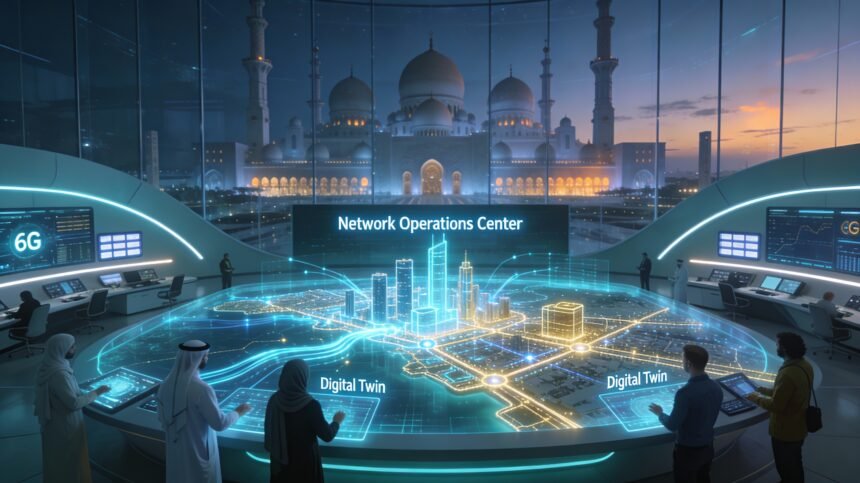
While the world is still settling into 5G, the UAE has officially activated its next-generation strategy. From 145 Gbps speed records to “holographic telepresence,” here is why 2026 is the year the internet becomes invisible.
For most nations, the conversation around 6G is theoretical, a distant concept slated for the 2030s. In the United Arab Emirates, however, the future has a habit of arriving early.
This week marks a pivotal moment in the national digital strategy as the Telecommunications and Digital Government Regulatory Authority (TDRA) begins the operational phase of the UAE 6G technology roadmap 2026. Following the landmark launch of the National 6G Committee in late 2025, the focus has shifted from “planning” to “piloting.”
The stakes are high. 6G is not merely a faster version of 5G; it is the infrastructure of the “Cognitive City.” It promises to merge the physical, digital, and biological worlds, enabling technologies that currently exist only in science fiction.
The Speed Barrier Broken: 145 Gbps and Counting
The cornerstone of this new era is speed, unimaginable speed. In a groundbreaking pilot that has set the global benchmark, e& (formerly Etisalat) and NYU Abu Dhabi recently achieved a data throughput of 145 gigabits per second (Gbps).
To put this in perspective: this is approximately 100 times faster than the average 5G connection. At this speed, a user could download 500 hours of 4K video in a single second.
“This is not just a speed race,” says Dr. Marwan Bin Shaker, a technology officer involved in the trials. “Achieving 145 Gbps on the Terahertz (THz) spectrum proves we can support ‘Holographic Telepresence.’ In 2026, we are moving beyond video calls. You will be able to project a life-sized, high-fidelity 3D avatar of yourself into a meeting room in Tokyo, in real-time, with zero latency.”.
The “Cognitive” Shift: AI-Native Networks
The defining feature of the UAE 6G technology roadmap 2026 is the integration of Artificial Intelligence directly into the transmission waves. Unlike 5G, where AI is an add-on, 6G is “AI-Native.”
The network itself is designed to “think.” It can sense the environment, effectively turning radio waves into radar. For the UAE’s autonomous transport goals, this is revolutionary. A 6G network doesn’t just let a self-driving taxi talk to the cloud; it allows the network to see a pedestrian stepping off the curb and warn the car instantly, even if the car’s own cameras miss it.
Read More: The End of Red Tape: UAE’s ‘Zero Bureaucracy’ 2026 Era
Infrastructure Overhaul: The “Hollow” Fiber Revolution
Supporting these wireless speeds requires a massive upgrade to the wired backbone buried beneath our streets. In preparation for the 2026 rollout, e& has successfully trialed “Hollow-Core Fiber” technology.
Unlike traditional glass cables, these new cables carry light through a hollow air channel, reducing latency by 30%. This is critical for high-frequency trading and remote surgery, where a millisecond delay can cost millions of dirhams or even lives.
The National Committee: A Unified Front
The execution of the UAE 6G technology roadmap 2026 is being overseen by a specialized “6G Committee,” a unified body comprising the TDRA, telecom giants, and Khalifa University.
They have established two dedicated working groups:
- The R&D Working Group: Led by Khalifa University, focused on developing homegrown IP and patents for 6G hardware.
- The Strategic Partnerships Group: Focused on ensuring the UAE has a seat at the table when global 6G standards are finalized by the ITU (International Telecommunication Union).
Read More: UAE Emiratisation 2026 Rules: The Executive Guide to the New Wage & Quota Era
What This Means for Residents
While consumer 6G smartphones are still a few years away, the impact of the UAE 6G technology roadmap 2026 will be felt this year in industrial and public sectors.
We expect to see the first “6G Zones” activated in controlled environments like Jebel Ali Port and NEOM’s logistics corridors. Here, “Digital Twins”, exact virtual replicas of physical ports, will operate in real-time, allowing managers to simulate and solve bottlenecks before they happen.
As the UAE allocates new spectrum in the 7-24 GHz range (FR3), the nation is sending a clear signal: The future isn’t something you wait for. It is something you build.