




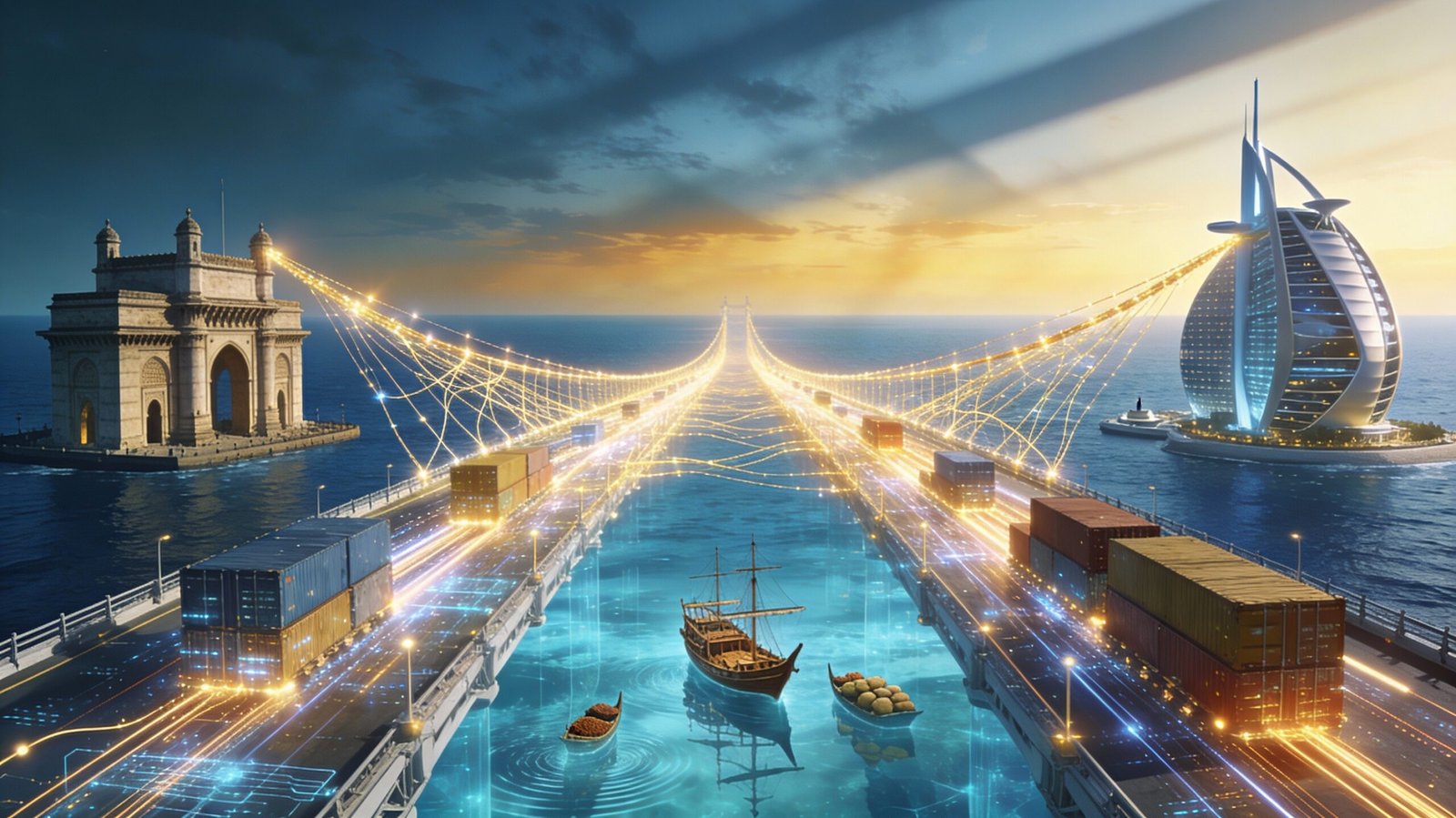
As bilateral trade targets $100 billion, the strategic alliance between New Delhi and Abu Dhabi is evolving from a transactional relationship into the world’s most critical economic bridge.
For centuries, the trade winds of the Indian Ocean have dictated the flow of wealth between the Middle East and the Subcontinent. Dhows carrying pearls and spices once connected the souks of Dubai to the ports of Bombay. Today, those dhows have been replaced by supertankers and fiber-optic cables, but the fundamental reality remains: The destiny of the Gulf is inextricably linked to the rise of India.
However, the nature of this relationship has undergone a radical transformation. For decades, it was transactional—defined by the export of hydrocarbons from the UAE and the import of labor from India. That era is over.
With the signing of the Comprehensive Economic Partnership Agreement (CEPA) in 2022, the India-UAE relationship has graduated to a Strategic Economic Alliance. With a bilateral trade target of $100 billion by 2030, this corridor is no longer just a trade route; it is the “New Silk Road” of the 21st century—a geopolitical stabilizer connecting the manufacturing engine of South Asia with the financial and logistical capital of the Middle East.
This article explores why this corridor is becoming the most vital artery in the global economy and where the smart money is positioning itself to capture the value flow.
The Logistics Super-Highway (IMEC & Beyond)
The geopolitical significance of the UAE lies in its geography. It is the hinge between the East and the West. This position has been supercharged by the proposed India-Middle East-Europe Economic Corridor (IMEC).
While geopolitical turbulence creates uncertainty, the underlying logic of the corridor remains sound: India needs a faster route to European markets, and the UAE is the necessary transit hub.
The DP World Factor: This is not just a government vision; it is backed by hard assets. DP World, the Dubai-based logistics giant, has invested billions into India’s logistics infrastructure, developing ports, inland terminals, and free zones. They are effectively building the “Hardware” of Indian exports.
- The Investment Play: For investors, the opportunity lies in “Intermodal Logistics.” Companies that can bridge the gap between Indian manufacturing hubs (like Maharashtra and Tamil Nadu) and UAE re-export zones (Jebel Ali) are seeing explosive growth. This includes cold-chain logistics, warehousing automation, and shipping tech.
The Currency Shift – De-Dollarization in Action
One of the most disruptive elements of this alliance is the move toward Local Currency Settlement (LCS).
In July 2023, the Reserve Bank of India (RBI) and the Central Bank of the UAE signed a framework to settle trade in Rupees (INR) and Dirhams (AED).
- Why this matters: This is a direct hedge against the weaponization of the US Dollar and swift fluctuations in Western monetary policy. By bypassing the dollar conversion, traders on both sides save on transaction costs and exchange rate volatility.
- The Signal: It signals a maturing of financial sovereignty. For UAE banks, holding Rupee reserves allows them to invest directly in India’s high-growth assets without currency friction. For Indian companies, paying for UAE oil in Rupees preserves their dollar reserves.
The Food-Energy Nexus
The symmetry between the two nations is economically perfect.
- The UAE has Energy, but needs Food.
- India has Food, but needs Energy.
This has led to the creation of a “Food Security Corridor.” UAE sovereign wealth funds (like ADIA and Mubadala) and conglomerates (like Emaar and Lulu Group) are investing heavily in “Food Parks” across India. These are dedicated agricultural zones where produce is processed and shipped exclusively to the UAE, securing the Emirates’ food supply chain against global disruptions.
Conversely, the UAE remains the guarantor of India’s energy security, not just through oil, but through partnerships in Green Hydrogen and solar grid interconnectivity.
The Investor Angle: This creates a massive opportunity in Agri-Tech. Startups that can increase yield, improve processing efficiency, or manage the supply chain of fresh produce from Punjab to Dubai are prime targets for UAE venture capital.
The Offshore HQ for ‘India Inc.’
Perhaps the most visible shift is the migration of corporate headquarters. Dubai has effectively become the offshore capital of India.
As Indian startups mature into “Unicorns,” they face regulatory friction and high taxes at home. The UAE, with its pro-business environment, Golden Visas, and the Dubai International Financial Centre (DIFC), offers a friction-less jurisdiction.
- The Trend: We are seeing a wave of Indian Fintech, Web3, and SaaS companies moving their holding structures to the UAE. They keep their engineering teams in Bangalore (cost arbitrage) but house their IP and Treasury in Dubai (sovereign protection).
- The Result: The UAE is importing India’s intellectual property and entrepreneurial energy, while India gets a global launchpad for its brands.
The Geopolitical Stabilizer
In a world fragmenting into rival blocs—US vs. China, Global North vs. Global South—the India-UAE corridor stands as a pillar of Non-Aligned Stability.
Both nations are masters of “Multi-Alignment,” maintaining strong ties with all major powers while prioritizing their own sovereign interests. This stability makes the corridor a safe harbor for global capital.
For the C-Suite executive, the lesson is clear: The India-UAE corridor is not just a regional story; it is a global one. It is where demographics (India’s youth) meets capital (UAE’s wealth). It is where manufacturing meets logistics. And for the next decade, it is where the highest risk-adjusted returns in the emerging markets will be found.