


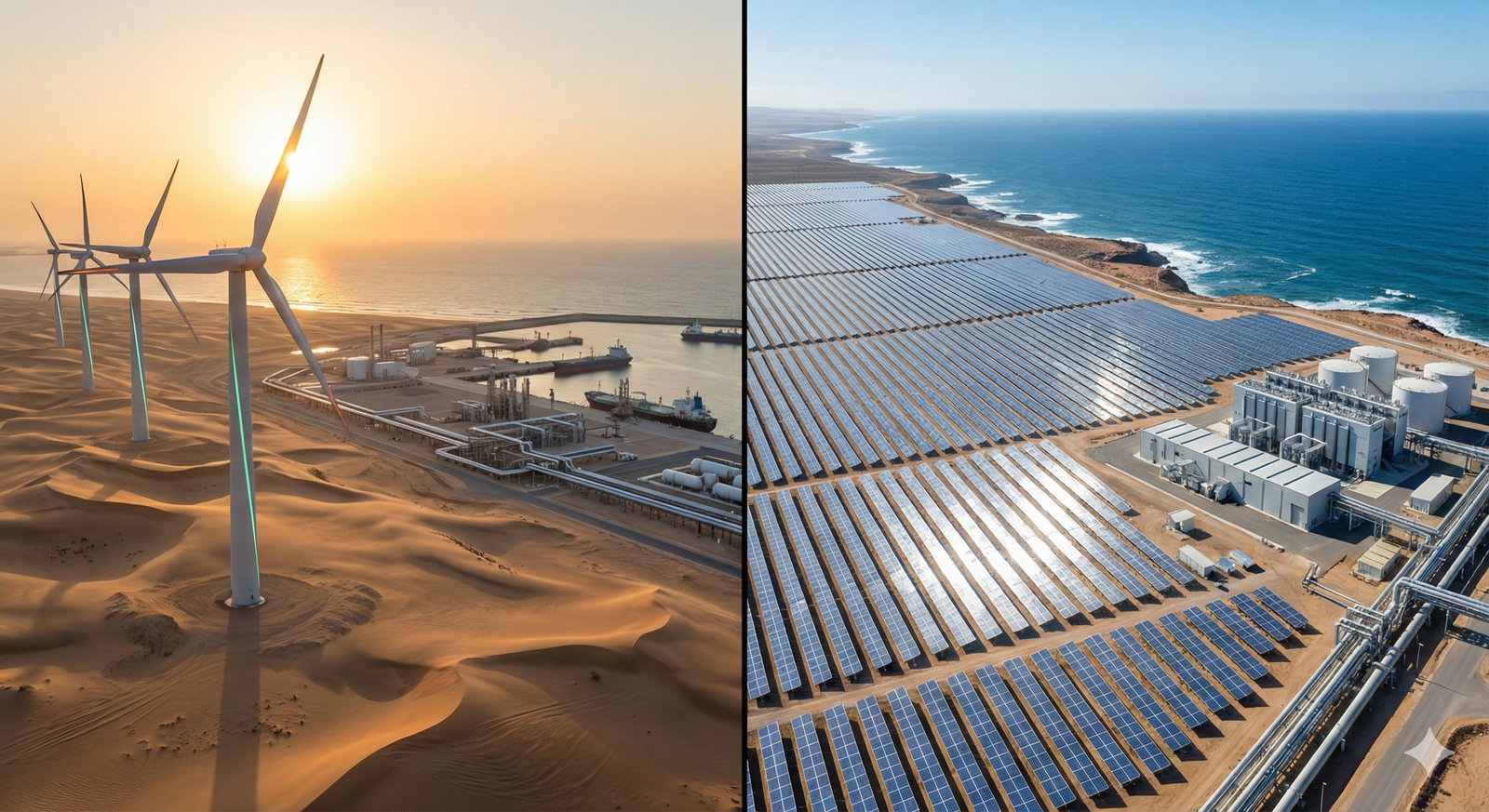
While the world talks about the energy transition, two Arab nations are building the infrastructure to power it. From the winds of Duqm to the Atlantic coast of Guelmim, here is how Oman and Morocco are becoming the batteries of the future.
For the better part of a century, the economic destiny of the Middle East was written in barrels of crude. But as 2025 draws to a close, a new narrative is emerging, one written in molecules of H2.
- While the world talks about the energy transition, two Arab nations are building the infrastructure to power it. From the winds of Duqm to the Atlantic coast of Guelmim, here is how Oman and Morocco are becoming the batteries of the future.
- Oman: The Institutional Powerhouse
- Morocco: The Gateway to Europe
- The “Sovereign Molecule”
- The Road Ahead
While Europe struggles with energy security and Asia hunts for decarbonization solutions, two nations, Oman and Morocco, have quietly but aggressively positioned themselves as the inevitable superpowers of the post-oil era. They aren’t just participating in the Green Hydrogen revolution; they are defining it.
This month, both nations made headlines that signal a maturity in the market. In Oman, the state-orchestrator Hydrom is recalibrating its massive auctions to ensure long-term viability. In Morocco, the “Offre Maroc” is rapidly turning land into export capability.
Here is why 2025 is the tipping point for the region’s Green Hydrogen ambitions.
Oman: The Institutional Powerhouse
Oman’s approach to Green Hydrogen has been nothing short of a masterclass in state planning. Unlike other nations that allowed a “wild west” of unregulated announcements, Oman created Hydrom, a central entity to orchestrate the entire sector.
The Duqm Reality Check
December 2025 has brought a moment of necessary market correction. While headlines noted BP’s exit from one specific project in Duqm, the broader ecosystem remains robust. BP remains committed to Hyport Duqm, and the reshuffling of portfolios signals a market that is moving from “hype” to “execution.”
“What we are seeing in Oman is the industry maturing,” says energy analyst Dr. Sarah Al-Lawati. “The projects that are staying are the ones with serious off-takers and realistic economics. Oman is targeting 1 million tons of green hydrogen production per year by 2030, and they are rigorously clearing the path to get there.”
The Asian Connection
Oman’s strategic advantage is its coastline. Located outside the Strait of Hormuz, ports like Duqm and Salalah offer a secure export route to hungry Asian markets like Japan and South Korea. By 2025, Oman has already allocated over 50,000 square kilometers of land an area roughly the size of Slovakia dedicated entirely to renewable energy generation.
Morocco: The Gateway to Europe
If Oman is the bridge to Asia, Morocco is the battery for Europe.
With the launch of the “Offre Maroc” (Morocco Offer), the Kingdom has rolled out the red carpet for investors. The government has identified 1 million hectares of land for green hydrogen projects, with 300,000 hectares released in the first phase alone.
The Chbika Breakthrough
The headline success of late 2024 and 2025 is the Chbika project in the Guelmim-Oued Noun region. A collaboration involving global giants like TotalEnergies, this project is not just a concept, it is a tangible step toward industrial scale.
Located near the Atlantic coast, Chbika leverages Morocco’s unique geography: fierce trade winds combined with intense solar irradiation. This “hybrid” resource allows electrolyzers to run for more hours of the day, driving down the cost of hydrogen production to levels that compete with fossil fuels.
The Pipeline Dream
Morocco’s ultimate trump card is geography. Unlike producers in Australia or Chile who must ship hydrogen as ammonia over vast distances, Morocco is looking at a direct pipeline connection to Europe. The proposed expansion of existing gas infrastructure to carry hydrogen would make Moroccan energy cheaper and faster to deliver to the EU than almost any other competitor.
The “Sovereign Molecule”
What links Oman and Morocco is a shared vision of “Sovereign Energy.” Both nations see Green Hydrogen not just as an export commodity, but as a tool for industrialization.
- Green Steel in Oman: By using local hydrogen to process iron ore, Oman plans to export high-value green steel rather than just raw gas.
- Green Fertilizers in Morocco: As one of the world’s largest phosphate producers, Morocco is using green ammonia to decarbonize its fertilizer industry, ensuring food security for the world while lowering its carbon footprint.
The Road Ahead
As we look toward 2026, the race is no longer about who can announce the biggest project. It is about who can break ground.
Oman and Morocco have chosen different paths, Oman via institutional orchestration and Asian exports, Morocco via European integration and aggressive incentives. But their destination is the same: a future where the Middle East remains the energy capital of the world, long after the last barrel of oil is sold.